


V6 vs V8 Engine Fuel Efficiency vs Horsepower: Which Should You Choose?
Choosing the right engine is a big decision for car lovers. We often debate between the thrill of powerful engines and the need for fuel efficiency in daily driving. It’s key to understand the trade-off between V6 vs V8 engine fuel efficiency vs horsepower which should you choose when picking your next car.
Today’s cars have made the choice between V6 and V8 engines less clear-cut. While some might prefer the power of bigger engines, new tech has leveled the playing field. Our guide on turbo vs naturally aspirated engine shows how modern tech changes your driving experience.
Your choice depends on what matters most to you: power, maintenance, or cost. We’re here to guide you through these technical choices with ease.
Key Takeaways
- Larger displacement blocks typically offer superior towing capacity and linear power delivery.
- Smaller configurations often provide better weight distribution, improving overall vehicle handling.
- Advancements in technology allow smaller units to compete with larger blocks in output.
- Daily driving habits significantly influence the real-world economy of your chosen powertrain.
- Maintenance requirements vary based on the complexity of the induction system used.
Understanding Engine Basics
Looking under the hood, we see the engine block’s layout. It shows engineering skill and power. Most cars have a V-style architecture, with two banks of cylinders in a V-shape. This design packs a lot of power into a small space, fitting in cars and trucks.
The V-shape makes the engine block shorter and stiffer than inline designs. This is key when comparing a V6 engine vs V8 engine. It helps balance weight and complexity.
What is a V6 Engine?
A V6 engine has six cylinders in two rows of three. It’s known for its versatility and smooth running. It’s compact, fitting well in many cars without taking up too much space.
Many like it for its good fuel economy and power. It’s common in mid-size SUVs and performance sedans. For daily driving, the V6 is often the better choice.
What is a V8 Engine?
The V8 engine has eight cylinders, in two rows of four. It’s all about high performance and lots of torque. More cylinders mean more power, great for towing or quick starts.
It’s bigger and heavier, but it sounds amazing and is very reliable under stress. The V8 is the top choice for trucks and muscle cars. Your choice depends on how much power you need.
Fuel Efficiency: V6 vs V8
When we look at different vehicle powertrains, the debate on gas mileage vs power is key. Many drivers find comparing a V6 engine vs V8 engine helps understand costs over time. Knowing which one fits your driving style is the first step to choosing wisely.
Comparing MPG Ratings
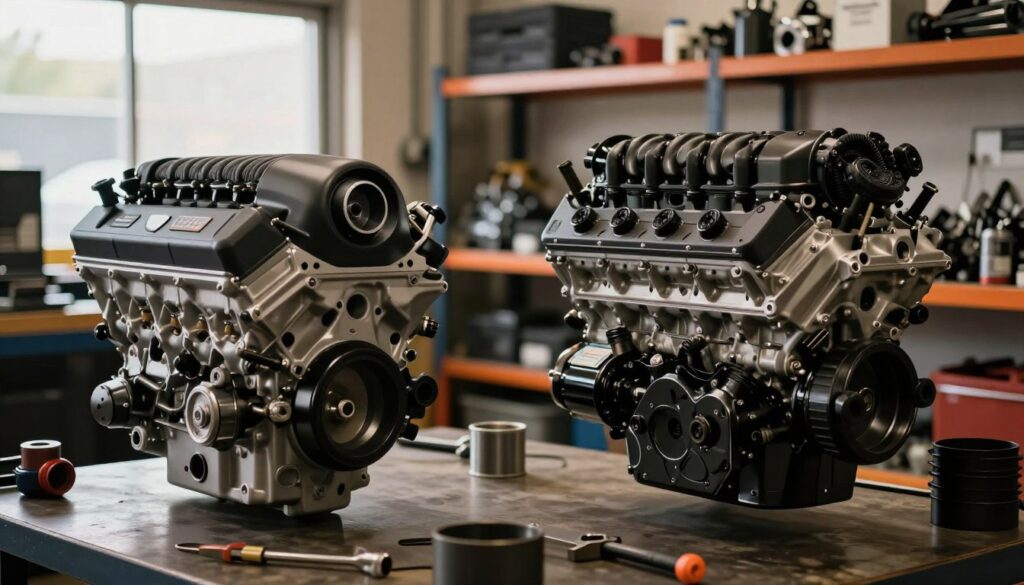
The V6 vs V8 fuel economy difference is clear in everyday driving. V6 engines balance performance and efficiency well, making them great for daily commutes. They use less fuel when idling or driving at steady speeds.
V8 engines focus on power. Even with modern tech, they can’t beat the fuel efficiency of V6s. If you want to save on gas, a V6 is usually the better choice.
Factors Affecting Fuel Efficiency
Several mechanical factors affect the fuel efficiency comparison between V6 and V8 engines. The main factor is the number of moving parts. V6 engines have fewer parts, which means less friction and power loss.
The engine’s total displacement also matters. Smaller engines need less fuel for each cycle. Choosing a V6 means a lighter, more efficient car that saves you money in the long run.
Horsepower: V6 vs V8
The horsepower difference between engine types greatly affects how a car drives. Horsepower measures how fast an engine can work, showing how quickly a car can move. This is key for speed and quick turns on the road.
How Horsepower is Measured
Engineers use a dynamometer to find horsepower. It measures torque at certain RPMs. Then, they use a formula to find the peak horsepower. This method helps compare different engine types fairly.
Old V8s were big and powerful. But now, turbocharging or supercharging makes smaller V6s strong. This means V6s can match V8s in power, yet use less fuel. This is great for those looking for top-rated sedans.
Performance in Real-World Scenarios
In everyday driving, the horsepower difference isn’t always clear. V8s give a smooth power that’s easy during highway merges. On the other hand, turbocharged V6s offer quick power at low speeds.
| Engine Type | Typical Power Delivery | Best Use Case | Efficiency Level |
|---|---|---|---|
| Naturally Aspirated V6 | Smooth, Linear | Daily Commuting | Moderate |
| Turbocharged V6 | High Low-End Torque | Sporty Driving | High |
| Naturally Aspirated V8 | High Peak Power | Towing/Heavy Loads | Low |
Your choice depends on what you value more. Do you want the quick power of a V8 or the balanced drive of a V6? Both have their own benefits, based on how you drive and what you need from your car.
Towing Capacity and Power
When comparing car engines, knowing how they handle heavy loads is key. The power needed to pull a trailer or haul heavy equipment is critical. While horsepower is important, torque is what really gets a heavy load moving.

Which Engine Handles Towing Better?
The V8 engine is top for towing because of its strong displacement and low-end torque. These engines are built to handle heavy-duty tasks without wearing out. They keep their power steady, even when going up steep hills with a full load.
A V6 engine needs to spin faster to match the V8’s pulling power. Modern V6s are better, but they can’t match the effortless strength of a V8. For those who tow often, a V8 is the better, more reliable and capable choice.
Ideal Uses for Each Engine Type
Choosing the right engine depends on your lifestyle and towing needs. If you only tow occasionally, a V6 is enough. It balances good fuel economy with occasional utility.
But, if you tow large trailers or heavy equipment, a V8 is a must. The table below shows how these engines perform in different towing situations during a typical car engine comparison.
| Towing Scenario | Recommended Engine | Primary Benefit |
|---|---|---|
| Light Utility Trailer | V6 Engine | Better Fuel Efficiency |
| Mid-Size Boat | V6 or V8 | Balanced Performance |
| Large Travel Trailer | V8 Engine | High Torque Output |
| Heavy Equipment | V8 Engine | Maximum Durability |
Acceleration and Speed
When we talk about car performance, the engine’s setup is key. Many drivers want their car to hit high speeds fast. They see this as a big part of the driving fun. But, modern tech has made different engine types almost equal in speed.
Curious about how engine type affects cost and performance? Check out our guide on hybrid vs plug-in hybrid total cost and fuel economy. It shows how various engines compare.
How V6 Engines Perform in Acceleration
Today’s V6 engines are super efficient. Thanks to turbocharging and direct injection, they accelerate fast. They’re great in sports sedans and crossovers, where power and weight matter.
V6 engines are light, making cars easy to steer in the city. They’re perfect for those who like quick turns and agile handling.
Why V8s are Often Preferred for Speed
V8 engines are top picks for raw power. They have more displacement and keep torque high across RPMs. This is why many fast cars and trucks use V8s.
V8s offer effortless speed and power. Even at high speeds, they have plenty of power left. This is why they’re often chosen for performance or towing.
Cost Considerations
When choosing between engine types, the sticker price is just the start. The cost of performance versus fuel efficiency is key. It’s important to balance gas mileage vs power for a smart financial choice.

Initial Purchase Price: V6 vs V8
Vehicles with V6 engines usually cost less than those with V8s. V6s are often seen as the standard or mid-tier option. This makes them more affordable for those on a budget. Choosing a V6 can save you thousands of dollars right at the dealership.
V8 engines, on the other hand, are often found in premium trims or heavy-duty models. They come with a higher price tag due to their complexity and engineering. This initial price gap is a big consideration for those who value affordability over raw power.
“Price is what you pay. Value is what you get.”
Long-Term Fuel Costs
The debate on gas mileage vs power doesn’t stop at the dealership. V6 engines are generally more fuel-efficient, leading to long-term savings. For those with long commutes, these savings can make up for the initial cost difference.
V8 engines, while powerful, require more frequent gas stops. This increased fuel use is a trade-off for their towing capacity and acceleration. It’s wise to calculate your expected annual mileage to understand how these costs affect your budget.
| Factor | V6 Engine | V8 Engine |
|---|---|---|
| Initial Cost | Lower | Higher |
| Fuel Efficiency | Higher | Lower |
| Operational Value | Budget-Friendly | Performance-Oriented |
The choice between V6 and V8 engines depends on your needs. If you value fuel efficiency, the V6 is likely the better choice. But if you need the heavy-duty capabilities of a V8, the higher fuel costs might be worth it for your lifestyle.
Maintenance and Longevity
Choosing the right engine type affects your repair costs over time. Knowing the mechanical differences helps predict future service needs. This ensures your vehicle lasts longer. Whether you prefer simplicity or power, each engine needs a specific care plan to stay in top shape.

Maintenance Requirements for V6 Engines
V6 engines are popular for their simple design. They have fewer parts than bigger engines, leading to lower repair bills. This makes them great for those who want reliable, easy-to-maintain cars.
Keeping a V6 engine running well is easy. Just remember to change the oil, replace filters, and check spark plugs regularly. By sticking to the manufacturer’s schedule, you can drive your V6 for hundreds of thousands of miles. For more details, check out our guide on V6 vs V8 engines to see how they stack up.
V8 Engine Maintenance Insights
V8 engines are powerful but need specialized care to stay efficient. They have complex cooling and lubrication systems that need close attention. Ignoring these needs can damage important parts early on.
V8 owners should be proactive with their maintenance. Use high-quality synthetic oils and premium parts to keep your engine running strong. While maintenance costs might be higher, the payoff is a powerful, long-lasting driving experience.
Driving Experience and Comfort
When you get into the driver’s seat, you feel the engine’s vibrations and sounds. It’s not just about numbers; how it feels matters a lot. The engine’s design is key to your daily drive.

How Engine Type Affects Driving Feel
Each engine type has its own feel due to how it fires. V8 engines are balanced, making them smooth and powerful. This balance is felt most at high speeds.
V6 engines, on the other hand, use balance shafts to balance out their design. They’re refined, but you might notice a different feel. This is clear when you accelerate fast or when the engine works hard.
Noise Levels: V6 vs V8
The sound of your car is a big part of the driving experience. V8 engines are loved for their deep, powerful sound. It’s not just loud; it’s the low sounds that make you feel stable.
V6 engines sound higher and more mechanical. Some like this sporty sound, but others prefer the V8’s deeper rumble. It comes down to what you like: a deep rumble or a sharp hum.
| Feature | V6 Engine | V8 Engine |
|---|---|---|
| Vibration Levels | Moderate | Very Low |
| Sound Character | High-pitched/Sporty | Deep/Authoritative |
| Smoothness | Good | Excellent |
| Driving Feel | Agile and Light | Solid and Powerful |
Best Applications for V6 Engines
Choosing the right engine is all about how you use your car every day. V6 engines offer a refined balance that many American drivers prefer. They work well in places where you need both efficiency and steady performance.
Ideal Vehicles and Use Cases
V6 engines are common in mid-size SUVs and sedans. They give enough power for highway merges and keep fuel use down for city driving. Family-oriented crossovers use V6s to handle steep hills without trouble.
For those stuck in traffic, a V6 engine is a blessing. It offers smooth power without the rough ride of smaller engines. It’s perfect for a reliable car that’s comfortable to drive every day.
When to Consider a V6
When picking an engine, think about your lifestyle. A V6 is ideal for those who drive on highways and do city errands. Check the table below to see if a V6 fits your driving style.
| Vehicle Type | Primary Benefit | Best Use Case |
|---|---|---|
| Mid-Size SUV | Balanced Power | Family Road Trips |
| Luxury Sedan | Smooth Delivery | Daily Commuting |
| Minivan | Reliable Torque | School Runs |
| Crossover | Fuel Efficiency | City Driving |
Choosing the right engine depends on your long-term plans. If you don’t need to tow heavy loads, a V6 is a great choice. It has enough power for most tasks and keeps costs down.
Best Applications for V8 Engines
The V8 engine is unmatched when you need raw power. Even as smaller engines get more efficient, the V8 engine is the top pick for those who want the best. Knowing V6 vs V8 is key to picking the right engine for your needs.
Vehicles that Shine with V8 Power
V8 engines are perfect for big vehicles that need to lift a lot. You’ll find them in full-size pickup trucks and large SUVs. These vehicles use the V8 to move heavy loads easily, making driving smooth and responsive.
In sports cars, the V8 is a favorite for its sound and power. Whether it’s a muscle car or a luxury car, the V8 offers a unique driving experience.
Off-Roading and Heavy-Duty Uses
Off-roading benefits from the V8 engine’s low-end torque. It helps drivers climb steep hills and rocky paths without trouble. This makes the V8 a must-have for serious off-road adventurers.
For heavy-duty work, the V8 is a must-have, not a luxury. It offers several key benefits:
- Superior Towing Capacity: V8 engines handle heavy trailers and equipment better.
- Hauling Power: They keep a steady speed when carrying heavy loads.
- Durability: These engines last long under heavy use.
If you often tow, haul, or drive on rough terrain, the V8 is your best choice. Its unmatched strength lets you handle any job with confidence.
Environmental Impact
Looking at how different engines affect the environment is key. The debate on engine types has become more about being green. We need to think about how our engine choice affects the planet through fuel use and emissions.
Fuel Economy Regulations
Car makers are under pressure to meet strict fuel economy standards. These rules push them to focus on fuel efficiency comparison across their models. Many are now using smaller engines to meet these goals without losing performance.
The difference in fuel economy between V6 and V8 engines has shrunk thanks to new tech. Turbocharging and hybrids help big cars meet emission targets. By picking a more efficient engine, you help the industry cut carbon emissions.
Emissions: V6 vs V8
Emissions are a big factor in a car’s environmental impact. Engines with fewer cylinders tend to pollute less because they use less fuel. You can check out V6 vs V8 engine performance to see the differences.
V8 engines give more power but often mean higher CO2 emissions. But, new tech like catalytic converters and exhaust gas recirculation systems have made V8s cleaner. Here’s a table showing the environmental trade-offs between V6 and V8 engines.
| Feature | V6 Engine | V8 Engine |
|---|---|---|
| Fuel Consumption | Moderate | High |
| CO2 Emissions | Lower | Higher |
| Regulatory Compliance | Easier | Challenging |
| Environmental Impact | Reduced | Significant |
Making Your Choice
Choosing the right powertrain means looking at your daily driving and long-term goals. It’s key to know what you need most. This helps you make a confident choice in the car engine comparison.
Key Considerations Before Buying
Consider if you need fuel efficiency for daily driving or power for heavy tasks. A V6 engine is great for family vehicles like the Nissan Pathfinder. It has enough power for most roads and keeps costs down.
If you often tow or haul heavy loads, a V8 engine is better. It gives you the torque needed for these tasks.
Personal Preferences and Lifestyle Choices
Your choice depends on what matters most to you while driving. Picking the right engine is a personal choice that meets your needs. We suggest trying out different models to see how they perform.
By matching your vehicle to your driving style, you’ll enjoy owning it for years.
FAQ
What is a V6 Engine?
A V6 engine has six cylinders in a “V” shape. It’s a smart design that fits well in smaller spaces. This makes cars like Toyota and Honda more agile and lighter.
What is a V8 Engine?
The V8 engine has eight cylinders in two banks of four. Brands like Chevrolet and Ford love it for its power. It’s great for heavy-duty tasks because of its strong build.
Comparing MPG Ratings
For daily driving, the V6 is usually the better choice. It uses less fuel than a V8, thanks to fewer parts and less friction. This means you save money on gas over time.
Factors Affecting Fuel Efficiency
Displacement and weight are key in fuel efficiency. V6 engines use tech like Variable Valve Timing (VVT) to save fuel. V8s, despite their power, often use more fuel because of their size.
How Horsepower is Measured
Horsepower shows how fast an engine works. Modern V6s, thanks to turbocharging, can match or beat V8s in power. This makes them a strong choice for speed.
Performance in Real-World Scenarios
V8s offer a smooth, consistent power boost. Turbocharged V6s, like in the Nissan GT-R, might have a slight delay before speeding up. It’s a matter of personal preference.
Which Engine Handles Towing Better?
For heavy towing, the V8 is the better choice. It has more power and torque, making it perfect for hauling heavy loads. Trucks like the RAM 1500 with a 5.7L HEMI V8 are great examples.
Ideal Uses for Each Engine Type
Use a V6 for light towing, like small boats or trailers. But for heavy loads, like horse trailers or large campers, a V8 is essential. It ensures reliability and power on steep hills.
How V6 Engines Perform in Acceleration
Modern V6s are quick off the line, thanks to their design. They’re lighter, which helps with handling and cornering speed. This makes them great for sports sedans.
Why V8s are Often Preferred for Speed
V8s are the top choice for speed, thanks to their instant power. Even with modern V6s getting faster, V8s offer a unique thrill. They’re perfect for track times and highway passing.
Initial Purchase Price: V6 vs V8
The V6 is often cheaper upfront. It’s the “base” option in many cars. But, the V8’s extra power might be worth the higher cost for some.
Long-Term Fuel Costs
Over time, the V6 saves money on fuel. It’s a smart choice for those who drive a lot. It keeps your budget in check.
Maintenance Requirements for V6 Engines
V6s are often cheaper to maintain. They need fewer spark plugs and less complex cooling. But, turbocharged V6s need special care to last long.
V8 Engine Maintenance Insights
V8s are known for lasting long, thanks to less stress. But, repairs can be pricier due to more parts. Regular maintenance is key to avoid premature wear.
How Engine Type Affects Driving Feel
The driving feel varies between V6 and V8 engines. V6s are zippy in the city, while V8s feel substantial and powerful. It’s a matter of personal preference.
Noise Levels: V6 vs V8
V8s are famous for their deep sound. V6s have a higher-pitched hum. While some prefer the V8’s noise, others enjoy the V6’s smoothness.
Ideal Vehicles and Use Cases
V6s are perfect for family SUVs like the Honda Pilot or Toyota Highlander. They offer enough power for merging and good fuel economy. It’s a great choice for most drivers.
When to Consider a V6
If you drive a lot in the city and occasionally go on trips, a V6 is ideal. It balances power and fuel efficiency well, making it a smart choice for many.
Vehicles that Shine with V8 Power
V8s are the top choice for luxury and performance. Cars like the Cadillac Escalade or Ford Mustang GT rely on V8s for prestige and power. They define the vehicle’s identity.
Off-Roading and Heavy-Duty Uses
For off-roading, the V8 is unbeatable. It provides the torque needed for rocks and mud. It’s also durable for heavy-duty tasks.
Fuel Economy Regulations
Stricter emissions standards are pushing toward V6 engines. Manufacturers aim to meet Corporate Average Fuel Economy (CAFE) standards. This shift is making V6s more common, even in heavy-duty vehicles.
Emissions: V6 vs V8
V6s generally emit less CO2 than V8s because they use less fuel. For those who want to reduce their carbon footprint but don’t want to go electric, a V6 is a good choice.
Key Considerations Before Buying
Think about your needs and wants before choosing. Ask if you really need the V8’s power. Being honest about your driving habits helps avoid unnecessary costs.
Personal Preferences and Lifestyle Choices
Choosing the right engine is personal. If you love the V8’s sound and power, it’s worth it. But, if you prefer modern tech and lower costs, a V6 might be better.
Between a V6 engine vs V8 engine, which is better for a daily commuter?
A V6 is better for daily driving because it’s more fuel-efficient. It’s great for city driving and merging on highways.
How significant is the horsepower difference in modern engines?
Modern V6s have narrowed the power gap with V8s. Many V6s now match or beat older V8s in power, thanks to turbocharging.
Which engine is better for a car engine comparison involving towing?
For towing, the V8 is better. It has more torque for heavy loads. Trucks like the Chevrolet Silverado benefit from its power.
What should I know about gas mileage vs power when choosing an engine?
V8s use more fuel but offer more power. V6s are a better balance, providing enough power for most tasks while saving on gas.
Is there a noticeable V6 vs V8 fuel economy gap for highway driving?
Yes, V6s are more fuel-efficient on highways. Modern V8s with cylinder deactivation can be close, but V6s usually win.
What are the main factors in choosing the right engine variant for a family SUV?
Consider your passenger load and towing needs for a family SUV. A V6 is often the best choice for its balance of performance and cost.
Do V8 engines last longer than V6 engines?
V8s have historically lasted longer due to less stress. But, with proper care, a modern V6 can also last over 200,000 miles.
Is the maintenance cost higher for a V8?
Yes, V8s usually cost more to maintain. They need more oil, spark plugs, and complex repairs. Regular care is essential for longevity.
Which engine offers a smoother driving experience?
V8s are generally smoother due to their firing order. This cancels out vibrations, making them more refined at high speeds.
Are V6 engines becoming more popular than V8s?
Yes, V6s are gaining popularity as emissions standards get stricter. Many trucks, like the Toyota Tundra, now offer powerful V6 options.

Hi! I’m Moheen Iftikhar, the person behind «CarCruisei». I’m deeply interested in the automotive world, from new car trends and advanced vehicle technology to useful driving advice. On this platform, I publish informative car reviews, expert insights, and practical tips to keep every car enthusiast informed and inspired.